
The Challenge
Scaling Enterprise Automation Without Compromising Governance
Many organizations begin automation with individual workflows, quick connectors, and manual configuration. This works for simple tasks but becomes difficult to manage when automations expand across teams, systems, approvals, APIs, and business-critical processes.
The challenge was not only building n8n workflows. Teams needed a stronger way to capture requirements, generate workflow logic, validate behavior, review changes, deploy with confidence, and monitor performance after release.
As the number and complexity of workflows increased, maintaining consistent development practices and operational visibility became increasingly important. Without a coordinated lifecycle, teams faced additional effort in evaluating automation quality, managing changes, and maintaining production reliability.
Key challenges included:
- Fragmented workflow creation: Requirements, build logic, reviews, and deployment decisions often lived in separate steps.
- Limited lifecycle ownership: Teams needed better control from initial request through testing, deployment, and operations.
- Reliability and governance gaps: Growing workflows needed evaluation, validation, monitoring, and governance before production use.
- Manual review overhead: Technical teams spent effort checking workflow quality, security, and operational readiness.
- Hard-to-scale operations: As automation increased, consistency, visibility, and repeatability became harder to maintain.
- Production risk: Business-critical workflows required stronger controls to prevent silent failures and workflow drift.
Codimite's Solution
Building a Governed Platform for the Complete n8n Workflow Lifecycle
Codimite built Atamaton as an enterprise-grade agentic automation platform that adds workflow lifecycle ownership, evaluation, governance, and reliability to n8n automation. Instead of treating automation as disconnected workflows, Atamaton introduces a structured platform layer that helps teams move from requirements to governed production workflows.
The solution combines AI-assisted workflow generation, n8n orchestration, evaluation logic, governance controls, and monitoring into one managed automation lifecycle. This creates a coordinated environment where workflows can be developed, reviewed, deployed, and continuously improved through a more consistent process.
Atamaton organizes workflow management around four interconnected capabilities:
- Requirements: Capture business goals and process requirements to establish the foundation for workflow development.
- Builder: Support workflow logic generation and n8n workflow creation using AI-assisted capabilities.
- Evaluator: Test, validate, and assess workflow reliability before production deployment.
- Governor: Support workflow monitoring, versioning, review, and ongoing operational improvement.
This agent-supported approach helps connect the early stages of automation development with production operations. Requirements inform workflow generation, evaluation supports deployment readiness, and governance provides the operational visibility needed to manage workflows over time.
The platform also introduces stronger lifecycle ownership. Rather than relying on isolated manual reviews, teams can manage workflow quality, versioning, change control, and operational monitoring within a coordinated governance framework. This is particularly valuable for enterprise environments where automation processes span multiple departments and business systems.
Technical Architecture: Agentic Governance and n8n Orchestration
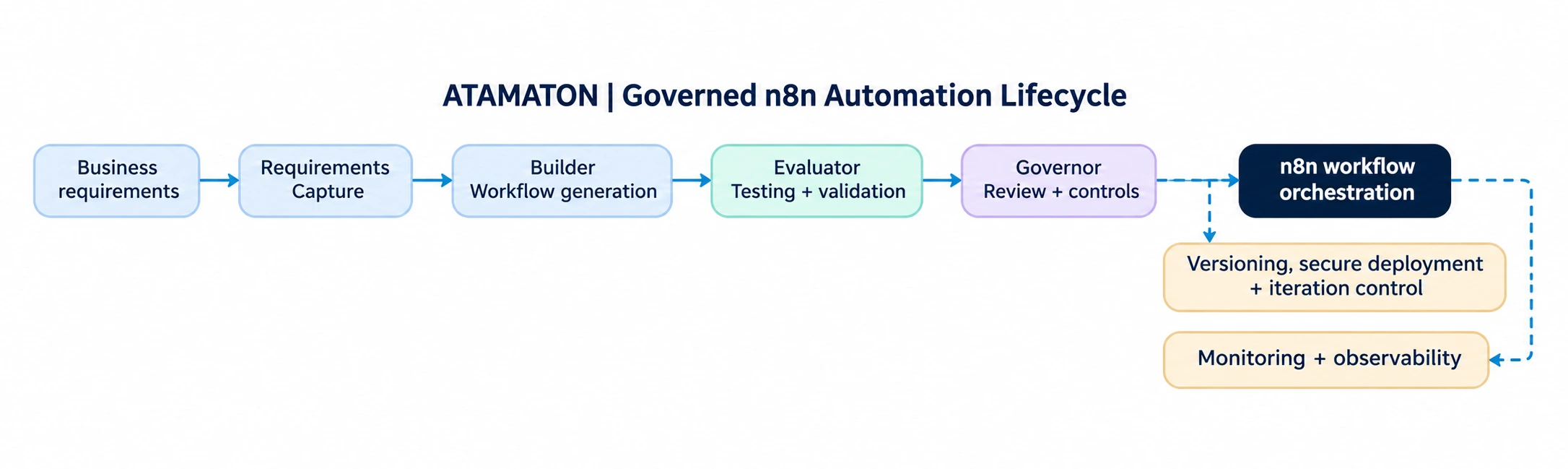
At the architectural level, business requirements move through an agentic governance layer supporting workflow generation, evaluation, and operational controls before connecting with n8n workflow orchestration.
Monitoring and observability help teams detect issues and assess workflow behavior, while secure deployment and iteration controls support continued maintenance. The platform also connects with APIs, business tools, cloud services, and data sources to support enterprise automation requirements.
By combining these capabilities, Codimite established a structured foundation for managing the full n8n workflow lifecycle, from initial requirements through production operations and ongoing improvement.
Business Impact
A Scalable Foundation for Production-Ready Automation
Atamaton established a more reliable approach to enterprise automation, helping teams move beyond individually managed workflows toward a governed automation lifecycle.
The solution delivers three key operational benefits:
- Faster Delivery: Teams move from requirements to workable automation designs with less manual setup.
- Stronger Governance: Workflow review, ownership, deployment readiness, and controls are easier to manage.
- Reliable Operations: Automations become more observable, testable, and maintainable as processes scale.
With AI agent coordination, workflow evaluation, governance controls, and monitoring working together, the platform provides a foundation for building and maintaining production-ready automation across enterprise environments.